Save 50% on a 3-month Digiday+ membership. Ends Dec 5.
German publishers keen for more dialogue with Facebook on its fake-news crackdown

Facebook has chosen Germany as the next country outside of the U.S. to test tools that filter out fake news, but details of how exactly this will work have been thin, leaving publishers keen for more face time with the social media giant.
Facebook readers in Germany can flag dubious stories, which are then forwarded to Correctiv, a well-respected local third-party fact-checking organization. If a story is deemed unreliable, it will be de-prioritized in the news feed. Users can still share the post, but they will see a warning telling them it has been disputed. Facebook is also clamping down on those who make money through programmatically served ads alongside fake-news articles. These features were announced in the U.S. in December.
“It’s a first step, and it is appreciated that they are now moving, but it is a bit late,” said Oliver von Wersch, managing director at German magazine publisher Gruner + Jahr.
Still, Facebook appears committed to quashing the problem. It has had meetings with various media organizations across seven European countries to help deal with fake news. But these efforts aren’t reaching all interested parties.
“I’d love to have Facebook’s head of news on site to discuss with Gruner + Jahr editors how Facebook as a distribution channel could be better, and then build this into the platform,” said von Wersch. “This hasn’t happened in the past. There’s not significant enough resource that’s put into dialogue with publishers.”
Facebook has also been working closely with publishers to enhance Instant Articles. As of last week, a select group of media companies were invited to publish multiple articles within each post. The goal is to help readers easily recognize whether news has come from a well-known source.
However, the speed with which Facebook has been pumping out initiatives lately — from its journalism project, Instant Articles update and mid-roll video ads — has concerned publishers that this has all been rolled out too quickly to solve a problem. “It feels like something that has been developed under pressure and in a short time frame. It doesn’t look like development work that’s been carried out for months,” said von Wersch. “If we really enter a serious dialogue, then we can get it solved, but it will be solved with publishers as partners rather than Facebook building its own editorial solution, that would be the worst outcome.”
Ad position: web_incontent_pos1
It’s a common sentiment.”The content is created by users. If users spread something illegal, Facebook must delete it, but Facebook does not have to curb the content of its users,” said Axel Springer chief Mathias Döpfner at the DLD publishing conference in Munich this week.
“At Wired Germany, we are very fond of the idea of adding transparency to Facebook postings,” agreed Domenika Ahlrichs, vice editor-in-chief of the Condé Nast title. “Adding more information empowers the users to make better decisions about what to trust and what to doubt. This decision should not be left to the company itself as it would contradict Facebook’s core value of interaction and would bear the risk of censorship.”
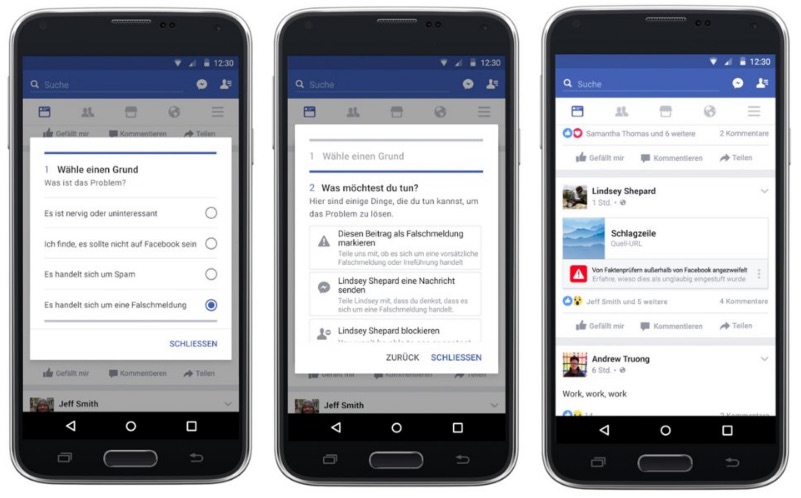
However, the road forward is vague: It remains unclear how Correctiv, a not-for-profit organization with a small team of journalists, can handle receiving potentially thousands of fake-news claims.
“It’s a good first step from Facebook,” agreed Christine Badke, senior editor at news publisher Kölner Stadt-Anzeiger. “On the other hand, you can’t outsource the problem. Facebook really has to work with politicians and media in a broader and more general way.”
Ad position: web_incontent_pos2
A Facebook spokesperson has responded saying: “Our team has been in close exchange with all major German publishing houses and we have received some very positive feedback. This includes partners that already signed up for the test. We hope to be able to communicate additional organizations as third party fact checkers in the future. We continue to be in constant dialogue with our media partners and value their feedback.”
Germany has shown it’s willing to take the hard line when it comes to fake news. In December, the chairman of Germany’s Social Democratic Party, Thomas Oppermann, called for companies like Facebook to open local offices to deal with stopping fake news, and if the platform fails to take down unreliable posts within 24 hours, then they will face fines of 500,000 euros ($523,320). Last week, Germany’s Justice Minister Heiko Maas, said fake news was endangering Germany’s culture of debate, and those responsible could face five years in jail.
More in Media

What publishers are wishing for this holiday season: End AI scraping and determine AI-powered audience value
Publishers want a fair, structured, regulated AI environment and they also want to define what the next decade of audience metrics looks like.

Digiday+ Research Subscription Index 2025: Subscription strategies from Bloomberg, The New York Times, Vox and others
Digiday’s third annual Subscription Index examines and measures publishers’ subscription strategies to identify common approaches and key tactics among Bloomberg, The New York Times, Vox and others.

From lawsuits to lobbying: How publishers are fighting AI
We may be closing out 2025, but publishers aren’t retreating from the battle of AI search — some are escalating it, and they expect the fight to stretch deep into 2026.
Ad position: web_bfu