Save 50% on a 3-month Digiday+ membership. Ends Dec 5.
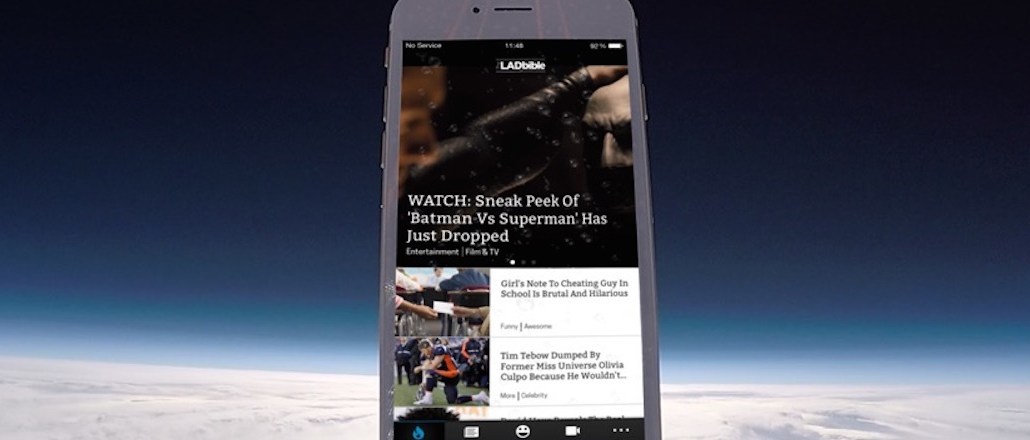
The Lad Bible has been trying to shed its beer-and-blokes image by covering more serious news content, a strategy that has extended to its first app on iOS. We talked with James Wigley, The Lad Bible’s commercial director, about how the publisher creates content for individual platforms and why it takes a conservative approach to display ads.
Why launch your first app now?
Our audience is young, mostly male and 85 percent mobile, so all our business is aimed at serving that, whether it’s our own site, Facebook, Instagram, Twitter, Snapchat, Vine or YouTube. The app was the next logical step.
How are you monetizing it?
It’s a mix of display, branded content and video pre-roll. We take a patient approach to monetization. One of the most significant decisions I make is often about when not to monetize. For instance, if we serve you a piece of video content under 60 seconds, we aren’t going to serve a 30-second pre-roll ad ahead of it.
What else do you have in the works?
In the new year, we’ll be rolling out apps for The Sport Bible, and then we’ll look at our other brands and ramp up our user-generated content-licensing business, The Content Bible.
Our mobile focus is very much on video and branded content. Our video team is expanding quickly, and next year, we are going to power-up our original storytelling. We’ve had some good results on Snapchat and Instagram with original video content, which has given us a sense of what is possible.
So what’s done well for you?
We did an exclusive feature for David Hayes’ comeback that received 1.3 million views on Facebook in the first 24 hours. A pared-down version on Snapchat received 1.9 million in 24 hours. Usually, we see more views on Facebook, but this shows us that Snapchat is increasingly an important part of our mix.
https://www.youtube.com/watch?v=FIcruPI9NA4
Ad position: web_incontent_pos1
What about branded content?
We did a “12 Hour Holiday” campaign with Doritos and OMD where they challenged our guys to have a holiday in Ibiza and be back to their desks by 9 in the morning. We created video for our website, streamed elements of the challenge on Periscope and Twitter, ran a short trailer on Instagram and used Snapchat for behind-the-scenes clips, which delivered a million Snapchat views in 24 hours. We obviously tailor content for where it’s going to sit: On Instagram, our video pieces are cinematographically beautiful; Snapchat is more raw and gets people closer to the story. Some media owners think of themselves as platform-agnostic, whereas we’re more platform-specific.
Young men are more likely to turn on ad blockers. How is this impacting you?
It’s not a massive issue for us. Ad blocking is a symptom of users who won’t stick around if you serve them a page with 100 different tags that eat up time and data. This is just the reality.
Images courtesy of The Lad Bible.
More in Media

What publishers are wishing for this holiday season: End AI scraping and determine AI-powered audience value
Publishers want a fair, structured, regulated AI environment and they also want to define what the next decade of audience metrics looks like.

Digiday+ Research Subscription Index 2025: Subscription strategies from Bloomberg, The New York Times, Vox and others
Digiday’s third annual Subscription Index examines and measures publishers’ subscription strategies to identify common approaches and key tactics among Bloomberg, The New York Times, Vox and others.

From lawsuits to lobbying: How publishers are fighting AI
We may be closing out 2025, but publishers aren’t retreating from the battle of AI search — some are escalating it, and they expect the fight to stretch deep into 2026.
Ad position: web_bfu