Save 50% on a 3-month Digiday+ membership. Ends Dec 5.
Digiday Research: Contextual targeting will have its renaissance

This research is based on unique data collected from our proprietary audience of publisher, agency, brand and tech insiders. It’s available to Digiday+ members. More from the series →
There is a lot of uncertainty about how the coming Google changes will affect the ad-buying habits of brands and agencies.
But publishers that have been hoping for a return to more contextual targeting can rejoice.
Digiday polled 146 buy-side professionals about how they and their employers were preparing for the end of the third-party cookie and found that slightly more than half of respondents said they would be spending more money on ad campaigns that used contextual ad targeting.
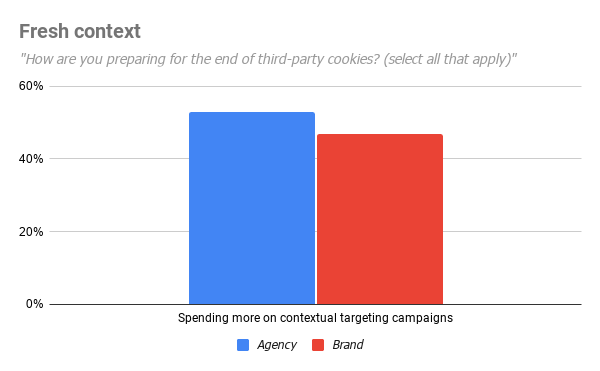
More respondents named contextual targeting among their approaches than “investing in technology to acquire more first-party data” and “using ad tech-built cookie alternatives.” Only one option — “revising attribution/measurement frameworks” — was selected by more respondents.
After years of losing ground to tracking tactics that allowed companies to track people’s behavior across the internet, contextual ad targeting has finally come back en vogue, partly because it offers ad buyers a mixture of privacy compliance and scale that, to date, third-party cookie alternatives do not.
It has also gotten considerably more sophisticated, as publishers have built their own identifiers and developed deeper, more nuanced understanding of the audience cohorts and segments their content attracts.
Ad position: web_incontent_pos1
Contextual targeting still presents challenges to ad buyers — there is no uniform definition or taxonomy for audience segments, for example.
But as ad buyers continue to prepare for the end of third-party cookies, significant numbers of them are going to gravitate toward what they know works, particularly as the coming changes scramble targeting and measurement methods that ad buyers have been honing for years — 69% of the survey’s respondents admitted that they were worried about their ability to target and measure ads without third-party cookies.


More in Media

What publishers are wishing for this holiday season: End AI scraping and determine AI-powered audience value
Publishers want a fair, structured, regulated AI environment and they also want to define what the next decade of audience metrics looks like.

Digiday+ Research Subscription Index 2025: Subscription strategies from Bloomberg, The New York Times, Vox and others
Digiday’s third annual Subscription Index examines and measures publishers’ subscription strategies to identify common approaches and key tactics among Bloomberg, The New York Times, Vox and others.

From lawsuits to lobbying: How publishers are fighting AI
We may be closing out 2025, but publishers aren’t retreating from the battle of AI search — some are escalating it, and they expect the fight to stretch deep into 2026.
Ad position: web_bfu