- 01 Is in-store media most like digital OOH, video or retail media?
- 02 How does in-store media support the shopper experience?
- 03 So, where exactly can I advertise inside a grocery store?
- 04 How can I make sure that in-store creative complements the shopping experience?
- 05 Got it. So how can I target the right audiences with in-store media?
- 06 Wait, how do I measure any of this?
- 07 How do I incorporate the grocery store into my media strategy?
This WTF guide, sponsored by Grocery TV, explores how marketers are reimagining in-store retail media to engage consumers inside the grocery store.
Even with the growth of digital channels such as e-commerce, social and CTV, the physical store remains one of the most influential moments in the path to purchase.
According to Grocery TV’s 2026 In-Store Shopper Perception Report, 95% of grocery shoppers make at least half of their purchase decisions in-store. Even younger, in-demand audiences frequent physical retail locations, with 55% of Gen Z consumers shopping in-store at least once a week.
Despite this, marketers have historically treated the store more like a retail backdrop than a media channel. Media buyers, especially digital media buyers, have long defaulted to other channels that were easier to tap into. For digital buyers accustomed to unified inventory, real-time optimization and closed-loop attribution, in-store was the opposite: a fragmented, retailer-by-retailer negotiation with no standardized metrics.
Now, in-store can be bought through a single platform, targeted with the precision of digital and measured across the funnel, making it possible to plan against the store with more sophistication.
Investment is following, with eMarketer projecting that U.S. in-store retail media spending will cross the billion-dollar milestone to reach $1.15 billion by 2029.
“We’re seeing advertisers lean in, testing and learning what works now that the infrastructure and measurement capabilities are in place,” said Marlow Nickell, co-founder and CEO of Grocery TV. “There’s a lot of opportunity ahead as more retailers launch their in-store networks.”
In this WTF explainer guide, Digiday and Grocery TV examine how savvy brands, retailers and agencies are leveraging the grocery store as a media channel. The majority of brand choice is made in a retail environment — not on TV or online — and now is the time for nonendemic and CPG marketers alike to rethink how they use the grocery store to engage audiences.
In-store grocery media uses digital screens placed throughout grocery stores to reach shoppers during their shopping trips.
The channel combines the strengths of three other established media channels: the reach and context of DOOH, the storytelling capabilities of video and the audience and commerce connection of retail media. These qualities come together inside the physical grocery environment, reaching consumers during their routine grocery shopping trip.
Nickell sees proximity to the purchase decision as the key distinction. “With digital out-of-home, it’s often more on-the-go media, like a billboard you’re driving past. In-store retail media is much closer to the point of purchase, where shoppers are making decisions and considering different products,” said Nickell.
Chelsea Monaco, svp, commerce media, Digitas North America, noted that this blending of channels makes classification tricky. “In-store retail media today can be categorized multiple ways, and it varies by the organization,” she said.
“The intersection of digital and in-store blurs in the retail media space, and the investment sources are so unique,” Monaco said. “I’ve typically seen it most categorized as shopper marketing, but investment source and where it sits in the organization depict the true categorization.”
Grocery trips offer more opportunities for product discovery than checking items off a list might suggest. Shoppers can encounter new products, respond to promotions and make unplanned decisions as they browse the aisles.
According to Grocery TV’s In-Store Shopper Perception 2026 report, 32% of shoppers enter the store without a list, and 78% make at least one impulse purchase during their trip.
In-store media can influence those decisions. Grocery TV research found that 62% of shoppers have purchased something directly after seeing it on an in-store screen. Screens are also shoppers’ top way to learn about sales, promotions and new products, allowing brands to directly engage shoppers at the point of purchase.
“When you ask people what they like most about grocery shopping, usually the answer is the discovery. They like the fact that they can see and hold things, and really learn about new products,” Nickell said. “That’s why we find shoppers are open to advertising. They’re already in a buying mindset.”
That opportunity is only growing. In 2026, shopper receptivity increased across every major store zone compared to Grocery TV’s 2023 study. Digital display formats saw an average 10-percentage-point increase in positive customer experience ratings, climbing from 41% to 51%. This suggests that in-store media can be relevant to a broad range of grocery shoppers.
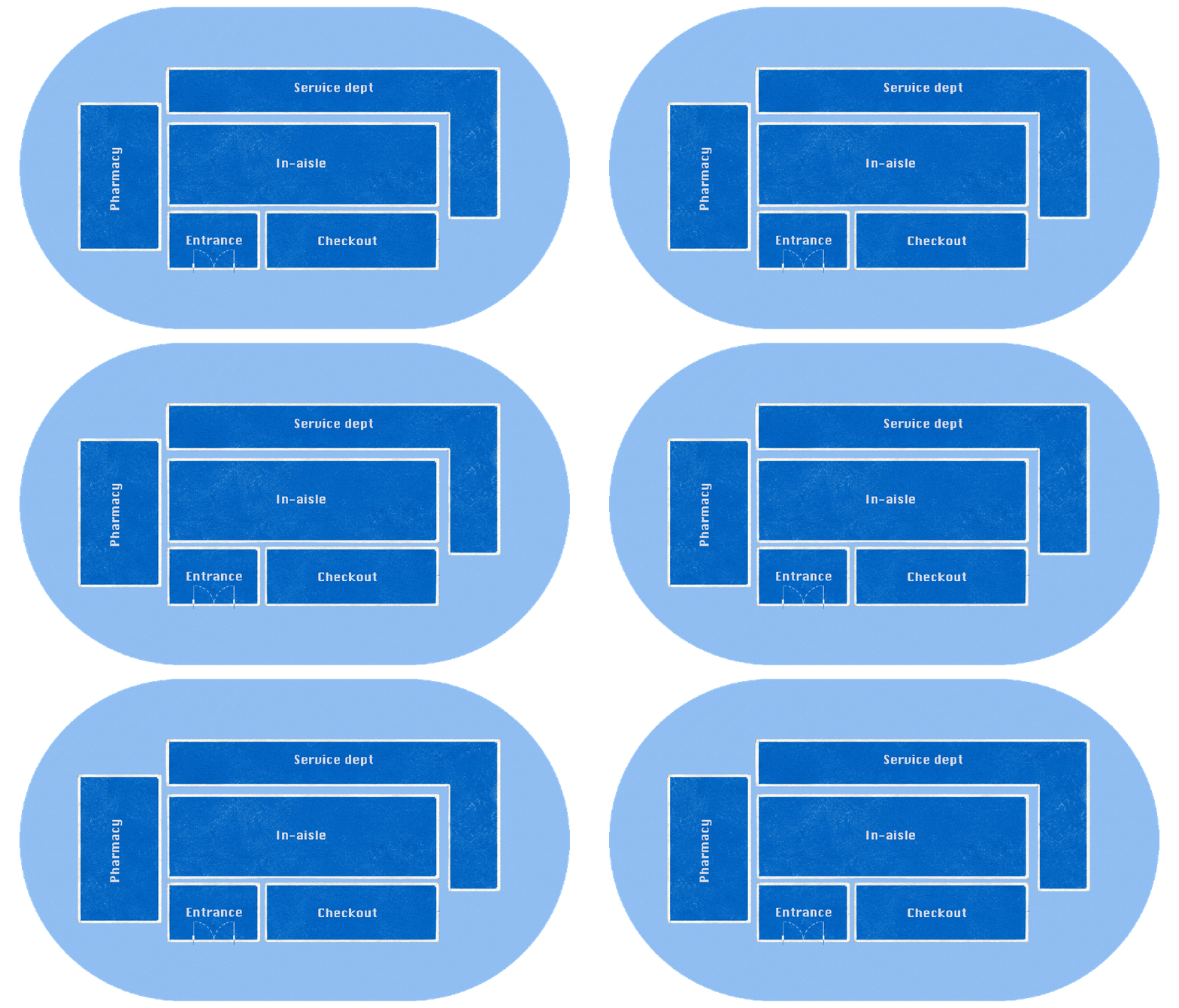
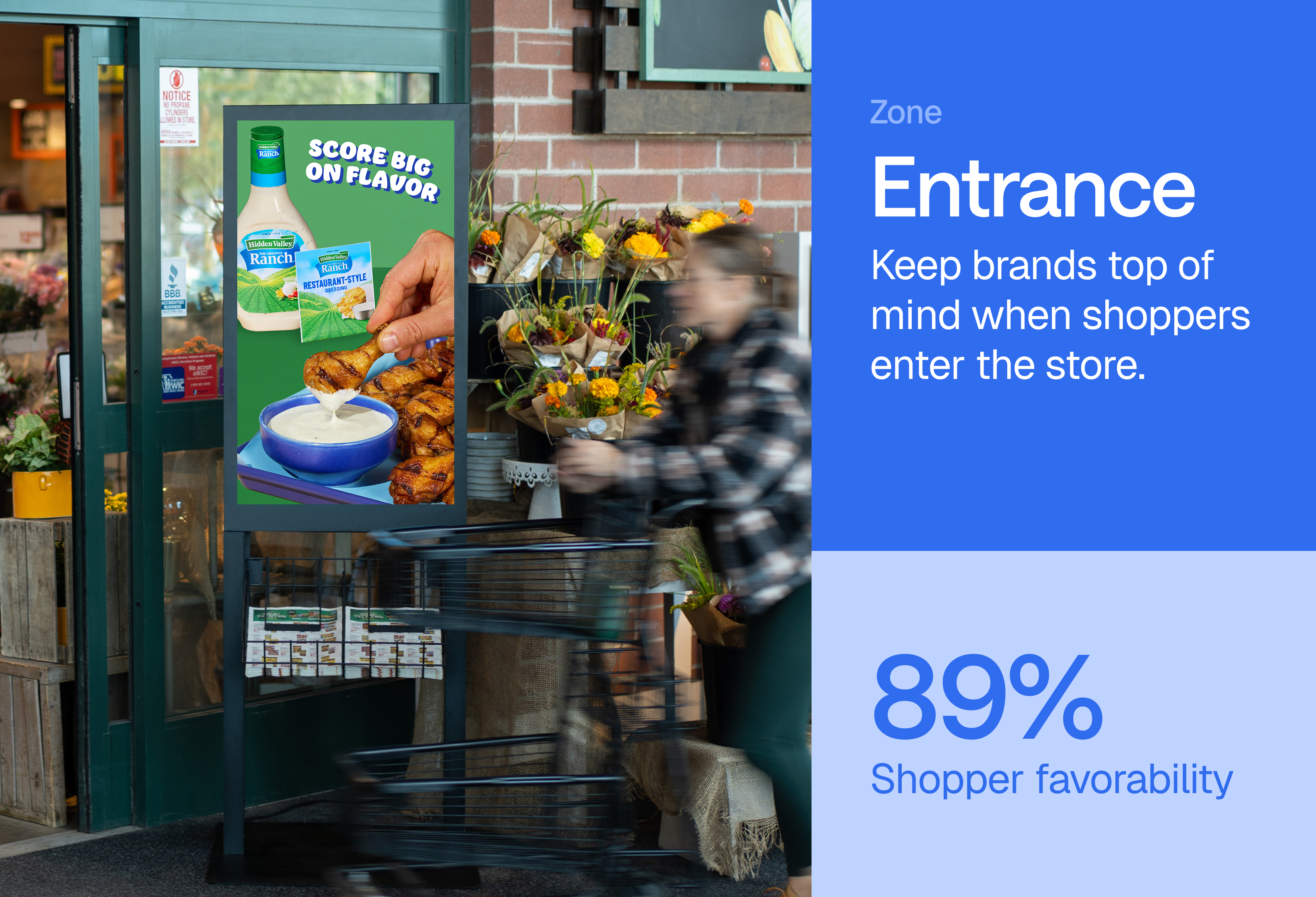
Grocery retailers with in-store media networks run digital screens throughout the store, concentrated in high-traffic and high-dwell spots like entrances and checkout where shoppers pass through or wait. Brands match their creative to the products and audiences they want to reach, such as a financial services brand connecting with shoppers as they wait at checkout.
“The screen is physically there in the environment,” Nickell said. “You don’t have to worry about an ad being blocked or scrolled out of view in the same way you do online.”
Where screens appear also matters. Research from Grocery TV shows that shoppers are more receptive to screens in high-dwell areas, where they naturally spend time waiting, such as the pharmacy, deli and checkout. Shoppers rated these zones as 84% favorable, according to Grocery TV’s 2026 In-Store Shopper Perception Report.
Entrances are another opportunity, as shoppers are accustomed to seeing signage there. By contrast, placements that interrupt the shopping experience, such as cooler screens, tend to be less popular.
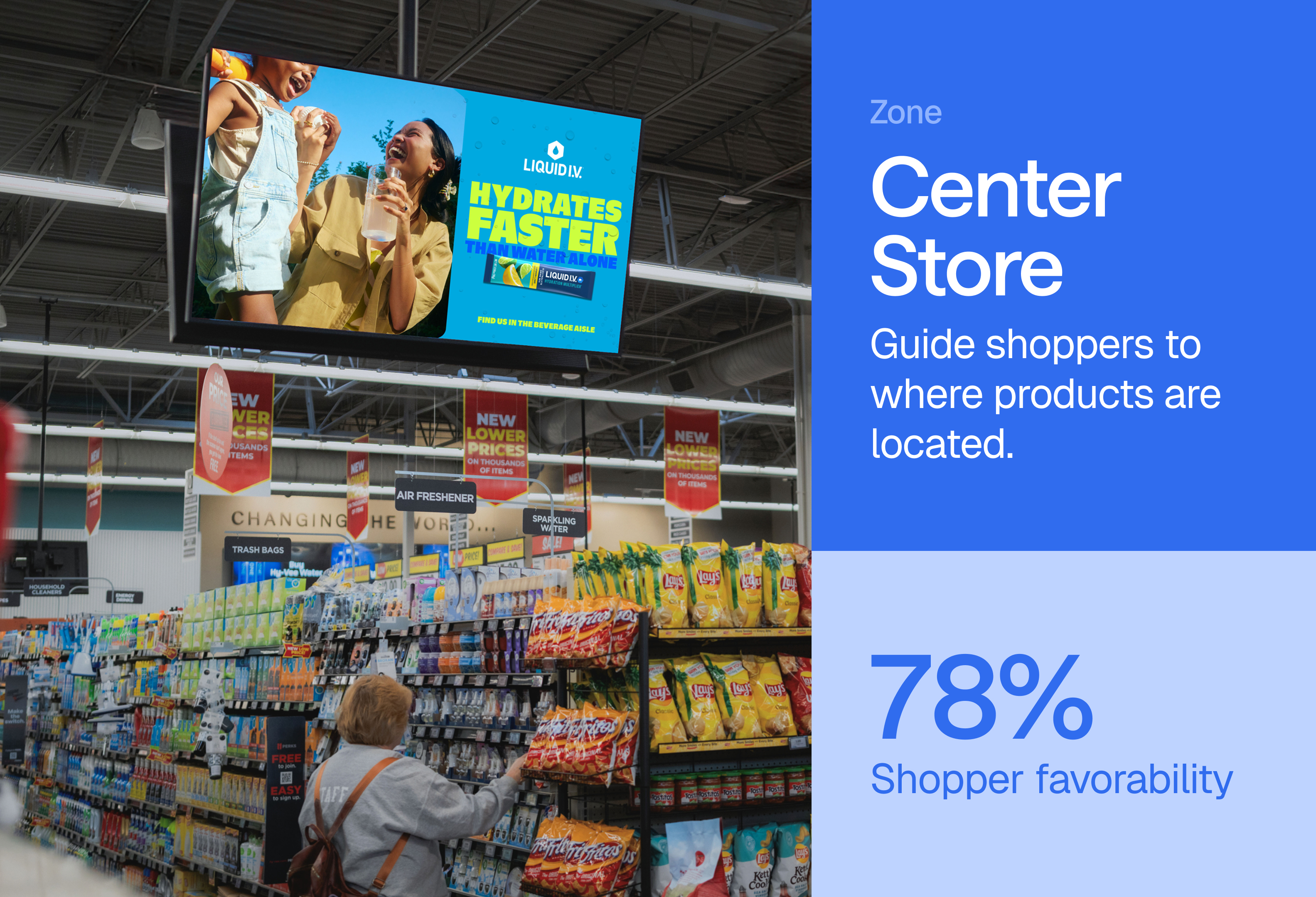
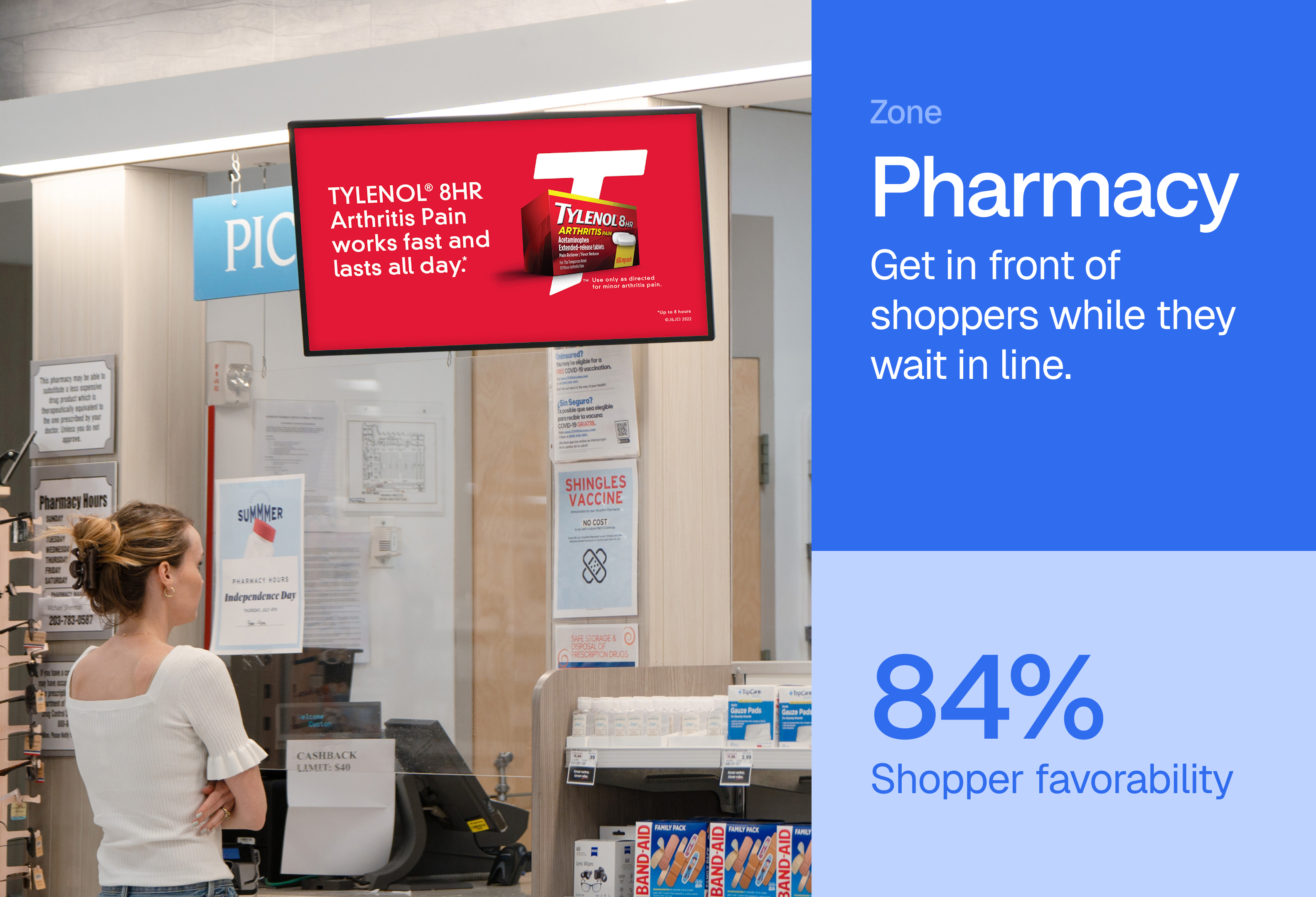
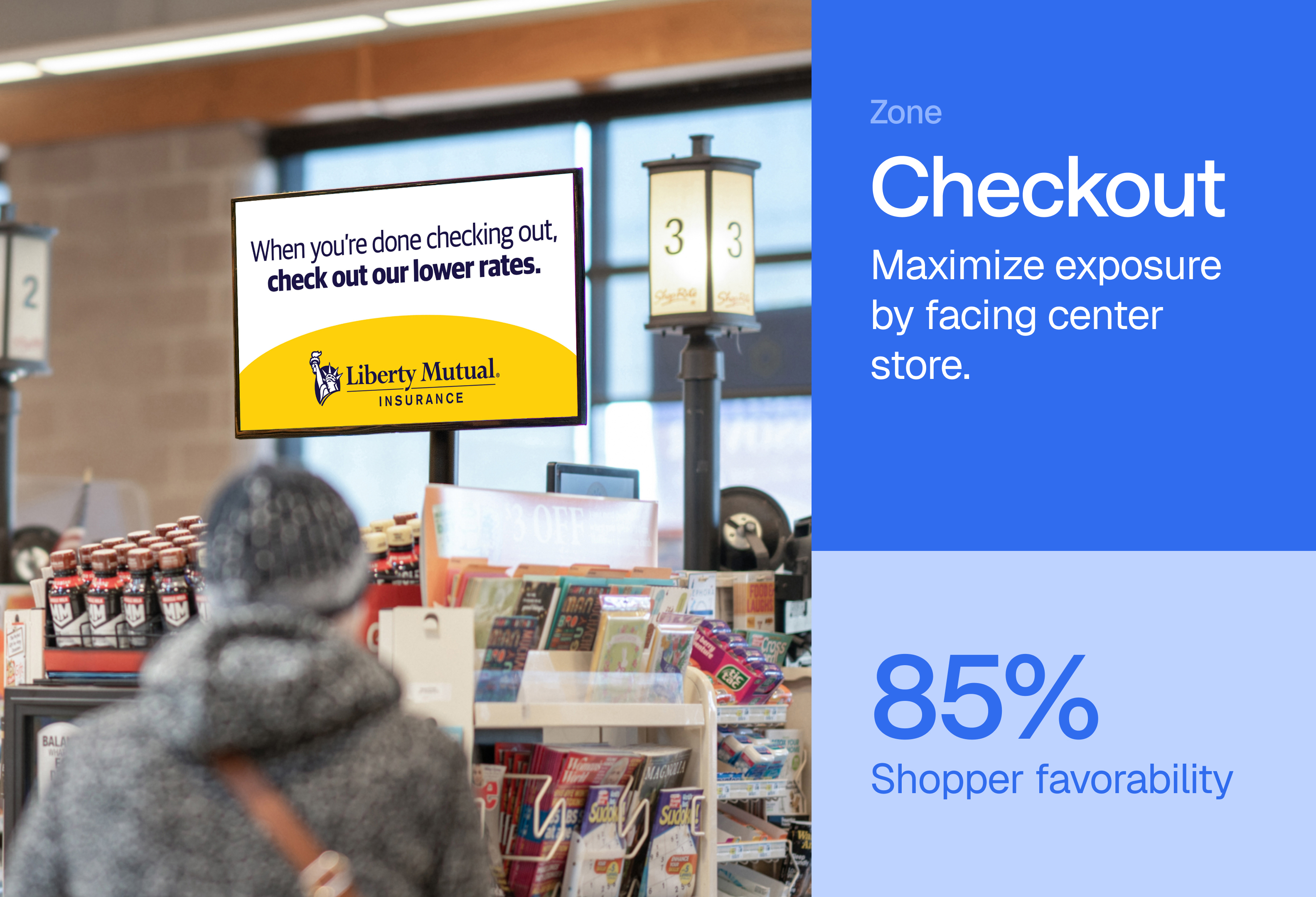
Effective in-store creative reflects both the product being advertised and the context in which shoppers encounter it. Brands can tailor messaging to the shopping environment, seasonal needs or specific audiences.
Nickell encourages brands to advertise across the entire store, with creative that connects to the shopping environment and gives shoppers a reason to engage beyond their planned purchases.
For instance, a snack brand might build a campaign around a game-day occasion, using creative that inspires shoppers to add something to their basket whether they see it entering the store or waiting at checkout. Education-forward content, such as recipes or tips for choosing an insurance carrier, can also give shoppers something useful to engage with during their visit.
Shoppers are 2.5 times more likely to consider a brand when an ad is contextually relevant to its environment, according to research from Grocery TV. The surrounding context can also shape how shoppers perceive an ad: 84% viewed end-cap ads featuring contextually relevant creative favorably or neutrally, compared with 79% for ads that were unrelated to the environment.
“As an industry, we often focus on the capability or the creative, but we forget about the overall experience,” Monaco said. “The biggest miss that I’ve seen is not connecting the entire shopper journey or that experience in how that shopper is going to engage with your brand in-store. What experience do you want that shopper to have with your brand at that touchpoint, and how does that fit in with all of the other omnichannel touchpoints they might experience?”
Brands getting started can adapt existing creative from channels such as CTV or social, making adjustments for the in-store environment. Text should be easy to read from a distance, and branding should be prominent. Over time, brands can develop creative specifically for in-store placements, incorporating context such as location, retailer and time of day.
As in-store media has evolved, audience targeting has become more sophisticated, bringing it closer to the strategies marketers already use in TV and digital campaigns. By combining geographic, demographic and behavioral signals with the context of the physical store, advertisers can reach shoppers close to the point of purchase with greater precision.
Geographic targeting can narrow a campaign by state, designated market area (DMA), ZIP code or point of interest. A brand looking to reach students and other campus communities, for example, could target grocery stores near universities.
Behavioral signals, such as purchase patterns and responsiveness to promotions, can help brands refine their audiences further. Demographic signals like age, income and household composition offer another layer. Brands can also prioritize stores that over-index for specific shopper groups, such as Hispanic consumers or older adults.
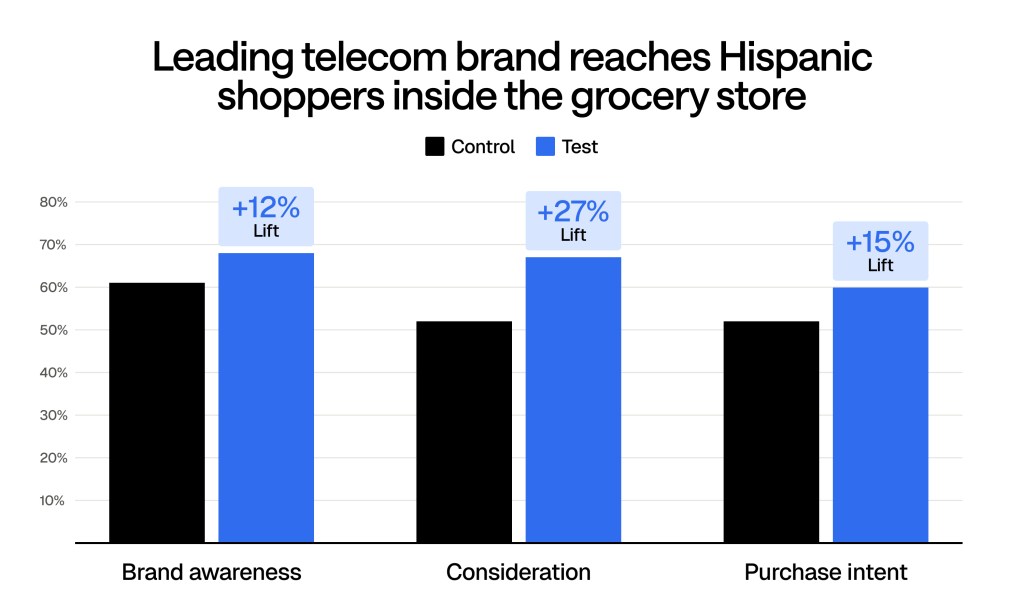
For example, a telecom brand promoted its international access plan across Grocery TV’s retailer-owned network in stores that over-index for Hispanic shoppers. The campaign drove a 27% lift in consideration for the brand when shopping for a wireless plan, a 15% lift in purchase intent and a 12% lift in unaided brand awareness.
As in-store media becomes easier to plan and buy, marketers have more ways to evaluate its impact, from brand awareness and consideration to incremental sales and repeat purchase. Yet measurement hasn’t always kept pace with the range of outcomes the channel can influence. A 2026 Grocery TV and IAB study found that, across four of five key outcomes, more marketers believe in-store media can drive those outcomes than they can currently measure those outcomes.
Part of the challenge is operational. Brands can struggle to align internal KPIs and standardize measurement across campaigns, while ownership of in-store media still sits largely with shopper marketing teams. The marketers getting the most from in-store take a broader approach, measuring beyond immediate sales and involving national media and brand teams.
Measurement should start with the campaign objective, using tailored methodologies to track different outcomes:
- Brand lift studies assess changes in awareness, consideration and purchase intent.
- Foot traffic and site visitation studies evaluate whether a campaign drives physical or digital visits.
- Sales lift studies, including matched-store tests and transaction-based analysis, measure incremental purchases.
Together, these approaches help advertisers assess performance across the funnel, using methods suited to the outcome they want to understand.
For example, a Grocery TV campaign for a financial health app measured brand impact against a control group, finding an 82% lift in brand rating, a 72% lift in recommendation and a 34% lift in brand awareness. The results show how in-store campaigns can be evaluated against objectives beyond immediate product sales.
“For banking, it makes a lot of sense to run ads at checkout. That’s when you’re pulling cards out of your wallet and making what, for most people, is the largest purchase of the week. Personal finances are already top of mind,” Nickell said.
Sales can be measured, too. In a campaign for Frito-Lay, Hy-Vee’s RedMedia and Grocery TV used a matched-store study across 103 stores, comparing test and control groups over a month. The campaign generated a 15% sales lift and a $7.94 return on ad spend.
Transaction-based measurement can also reveal effects beyond the advertised product. One national personal care brand working with Grocery TV saw a 15% sales lift for the advertised product, a 12% lift across complementary products and an 8% lift across its full brand portfolio.
The opportunity is to measure outcomes aligned with the campaign’s goals, including what happens after the initial purchase. In the IAB study, 75% of marketers who said they fully leverage in-store media measured post-purchase outcomes such as loyalty and repeat purchase, compared with 42% of those who said they underutilize the channel. Measuring beyond immediate sales can give marketers a fuller picture of the role in-store media plays in driving customer retention.
The grocery store can play a complementary role in an integrated plan, connecting brand messaging across channels with the moment shoppers are making purchase decisions. It starts with a clear business objective: What does the campaign need to achieve, and where could in-store contribute?
That may mean reconsidering how budgets are allocated across channels. “The ultimate question is what business outcome will drive the most success,” Monaco said. “We’ve seen cases where it might make sense to take budget out of underperforming digital and move it to in-store.”
A study from Grocery TV and MFour found that in-store media delivers an average of 49% incremental reach beyond existing media plans. Complementing campaigns on other channels with in-store media allows marketers to reduce overexposure by diversifying audiences. They can also maximize media dollars by driving new engagement and closing gaps left by other channels, such as display and online video.
Marketers don’t need to rethink their entire media mix to explore the channel, however. They can start with a defined objective, test in-store alongside other media and evaluate its incremental contribution to outcomes like brand lift or sales. Those findings can help determine where future investment will have the greatest impact.
In-store retail media is still developing as a full-funnel media-buying channel, giving early adopters an edge before it becomes a standard part of media planning. As Nickell noted, brands that start testing now can learn which creative works, how to measure success and how to make the case for investment internally. Those learnings take time to build. “The earlier you get started, the better,” Nickell said.