Save 50% on a 3-month Digiday+ membership. Ends Dec 5.
If you’re like most people, you probably haven’t thumbed through a phone book lately. Online search is where most of our fingers do the walking now.
To stay relevant with young consumers, the Yellow Pages renamed itself YP in 2012 and prioritized its digital properties. Now, it’s taking a familiar page from the brand playbook and launching a content strategy.
To that end, a new YP marketing campaign launches today called “Make Every Day Local,” featuring videos of news, sports and TV personalities including ESPN’s Hannah Storm and reality stars Bill and Giuliana Rancic talking about their favorite hometown businesses.
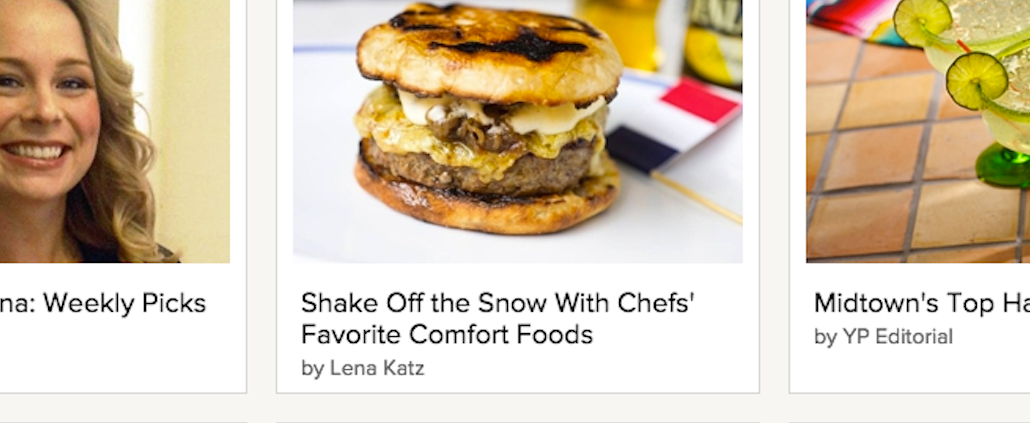
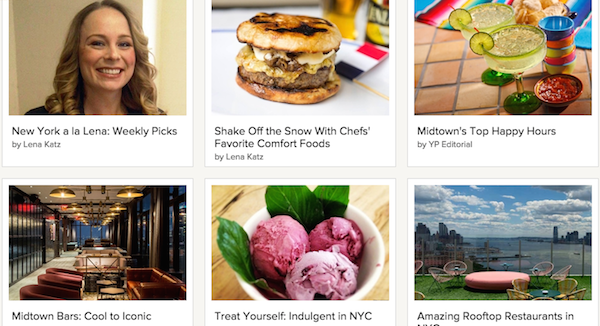
YP has also contracted with five local bloggers to write about food, which is YP’s most-searched category, with plans to add more bloggers in other business categories. They’re supplemented by a small in-house editorial team of people who write bite-sized reviews of local businesses, which are grouped into recommended collections aimed at people searching the site.
The platform is encouraging visitors to the site to post comments and tweet about local businesses as well. The content will reside on YP’s site, its app and a microsite, makeeverydaylocal.com. YP will also push it out on YouTube and social networks, where YP has a diminutive presence, with 12,500 Twitter followers and 531,755 Facebook likes.
Ad position: web_incontent_pos1
YP is trying to grow awareness with millennials, many of whom may have no connection to the brand. While the company expects to derive more than 50 percent of its ad revenue from digital this year, its name is still closely associated with those thick yellow directories. Allison Checchi, CMO of YP, said the content is designed to increase people’s engagement with the brand, which she’ll track by looking at metrics like repeat visits, change in awareness and app downloads.
“Content has to be meaningful to what your product does,” Checchi said. “For us, the experience is, how do I select a business? So that’s what our content needs to reinforce.”
With an editorial team and site that’s regularly fed by bloggers and user-generated content, YP is reminiscent of other brands, such as Adobe and GE, that are producing editorial content on an ongoing basis. Checchi stopped short of calling YP a publisher, though. “That’s not our core business,” she said. “You could say we’re a publisher of sorts. But I would like to think of ourselves as a conduit for people who publish. So a platform. And any consumer.”
Surrounding its local business results with editorial content can be a way for YP to stand out in a commoditized category, and using influencers can help YP tap into millennials, for whom the definition of what an “expert” is is broadening, said Andy Seibert, managing partner of Imprint, the content lab at marketing firm Sullivan NYC.
But by entering the content fray, YP is going up against established publishers such as New York magazine and Zagat and newer platforms like Eater and Yelp. Much of YP’s content has a generic feel, such as Midtown’s Top Happy Hours that helpfully reveals that “midtown is not the place to save big bucks.”
Ad position: web_incontent_pos2
As for its “influencers,” they hardly have giant social footprints, considering their market sizes. In New York, there’s Lena Katz, with just 1,670 followers on Instagram, while the San Francisco blogger Amy Sherman has 19,600 Twitter followers.
Seibert said YP could use a stronger point of view if it’s going to go up against such a big competitive set. “The quality of the content really has to be high,” he said. “Some of their pieces could use a little more attention. One of the pieces was about intellectual stimulation; I felt like I needed more to compete with Time Out [New York]. It’s got to be about the relevancy of their recommendations.”
More in Media

What publishers are wishing for this holiday season: End AI scraping and determine AI-powered audience value
Publishers want a fair, structured, regulated AI environment and they also want to define what the next decade of audience metrics looks like.

Digiday+ Research Subscription Index 2025: Subscription strategies from Bloomberg, The New York Times, Vox and others
Digiday’s third annual Subscription Index examines and measures publishers’ subscription strategies to identify common approaches and key tactics among Bloomberg, The New York Times, Vox and others.

From lawsuits to lobbying: How publishers are fighting AI
We may be closing out 2025, but publishers aren’t retreating from the battle of AI search — some are escalating it, and they expect the fight to stretch deep into 2026.
Ad position: web_bfu