Save 50% on a 3-month Digiday+ membership. Ends Dec 5.

Earlier this week, the newsroom at The Washington Post excitedly gathered to watch its real-time analytics dashboard Chartbeat soar past its record for concurrent traffic. But despite a seemingly inexhaustible supply of say-what political news, there are signs that attention is waning for political publishers.
Four months after Donald Trump’s inauguration, most politics-focused publishers are tallying monthly traffic totals that are flat, or sometimes even lower, than the totals they fetched during the same period last year, according to comScore data.
In April, Attn:, a policy-focused social publisher that’s quietly turned into a giant of distributed video, saw its monthly traffic totals drop more than 10 percent year over year. Politico’s declined 3 percent. The Daily Beast, which puts politics front and center on a menu of many topics, saw a steep drop, from over 18 million unique visitors to just 11 million. Even The Hill, which attracted more than twice as many unique visitors — 18 million — this past April than it did a year earlier, has seen its traffic decline for three consecutive months, down from a January high of 25 million unique visitors.
Politics is a seasonal interest for most Americans. But the slide should also give pause to the many publishers that were starting to put politics more front and center to capitalize on interest in the first reality-TV president, and it may also signal that it’s time for even the more laser-focused publications to begin broadening their coverage, particularly on platforms like Facebook.
“We always knew it would be a tough year-on-year comparison,” said Daily Beast editor-in-chief John Avlon. “But over the last year, we have significantly broadened our base.”
Ad position: web_incontent_pos1
As with most things related to publishers’ traffic, Facebook played a role here, too. About 40 percent of Americans get their news from Facebook, and it is the largest referral source of political news: 59 percent of the referral traffic to politics stories comes from Facebook, according to Parse.ly, far above the mean of 40 percent across all news and media categories.
And as the election becomes more distant, the engagement that some politics publishers have seen on Facebook has slipped. The Hill, for example, which averaged 4,000 engagements per post on Facebook over the past four months, has seen the raw number of engagements it’s getting on its Facebook posts decline from inauguration day heights but increase slightly from January, per NewsWhip.
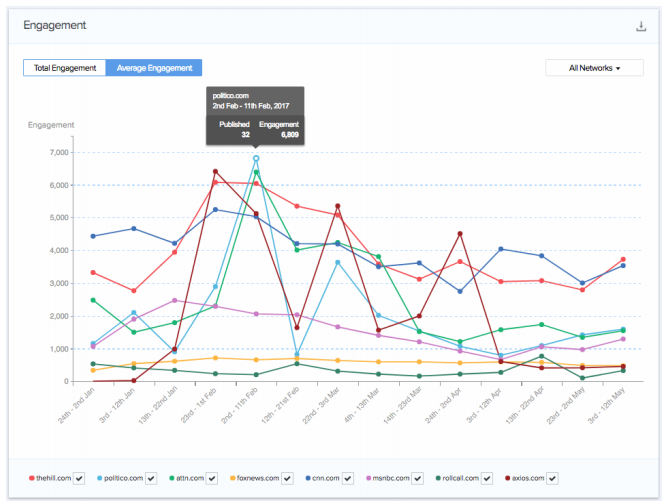
“Sure, people are going to try and extend that fever past its time,” said Jeff Liang, chief digital officer at media agency MDC Media Partners. “But I don’t think the political news sites, which are very niche, very category-specific, could have expected this to last much past the election itself.”
More in Media

What publishers are wishing for this holiday season: End AI scraping and determine AI-powered audience value
Publishers want a fair, structured, regulated AI environment and they also want to define what the next decade of audience metrics looks like.

Digiday+ Research Subscription Index 2025: Subscription strategies from Bloomberg, The New York Times, Vox and others
Digiday’s third annual Subscription Index examines and measures publishers’ subscription strategies to identify common approaches and key tactics among Bloomberg, The New York Times, Vox and others.

From lawsuits to lobbying: How publishers are fighting AI
We may be closing out 2025, but publishers aren’t retreating from the battle of AI search — some are escalating it, and they expect the fight to stretch deep into 2026.
Ad position: web_bfu