Join us Dec. 1-3 in Nashville for the Digiday Programmatic Marketing Summit

The old saw is that millennials may spend a lot of time-consuming media, but they’re far less likely to spend money on it.
But the latest forecasts complicating that narrative that millennials are media cheapskates loath to open up their wallets for content. Millennials in North America are expected to spend $62 billion on media content in 2015 — $750 per person — according to a new report from Deloitte. Nearly half of that spending will go to paid TV services, followed by music, computer games and movies. Still, media companies are facing an environment that’s far easier for people to find free alternatives.
“There’s no digital equivalent to a hamburger or car, but there is one for a CD or book,” said Deloitte Research director Duncan Stewart. “Media companies are under way more pressure.”
Stewart said he expects millennials decrease how much they spend on paid TV services over the next year as more companies launch and attract more people to their digital video services. The launch of a digital-only HBO Go service and Dish Network’s Sling TV streaming, which unbundles ESPN from the cable package, are clear signs of where the industry is headed.
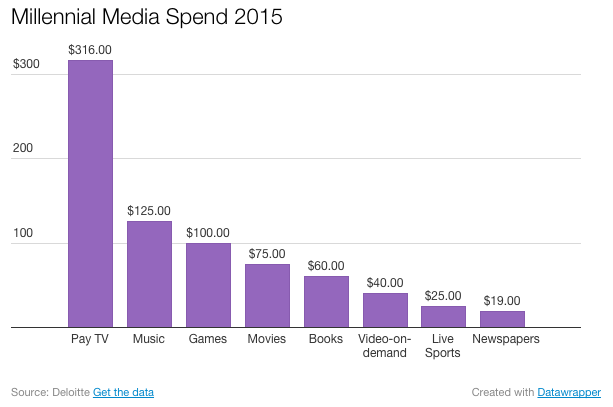
But of the big media formats, newspaper publishers have it the worst: Deloitte projects that the average millennial will pay just $19 on newspapers this year, less than the cost of four Sunday editions of The New York Times. Newspaper companies are also facing a similar money problem on the Web, which is eroding both their advertising revenue and ability to get money directly from readers. And they partially brought that fate upon themselves. “When you have people willing to give their content away for free, charging for it is really hard,” Stewart said.
Deloitte’s projections are just the latest in a long line of attempts to describe and quantify the spending habits of young people, whom analysts and surveys suggest are spending money very differently from previous generations. A recent survey from the Boston Consulting Group (PDF), for example, found that millennials are spending less money perceived as non-essential, such as luxury brands and restaurants, and more money on organic food and other natural products. Millennials are also spending less money on products and more money on experiences, according to a June 2014 survey from Harris Interactive.
Ad position: web_incontent_pos1
Duncan said that media companies can learn a lot from these shifts in spending habits. “It’s not that millennials don’t want to pay for things — it’s just that they don’t want to pay for the things that a lot media companies are making.”


More in Media
The clipping economy is changing as platforms crack down and creators seek control
The creator economy is shifting its stance on clipping as platforms crackdown; what does clipping look like in the future?

OpenAI rewrites ChatGPT Business Hub terms after legal language raises concerns
OpenAI revised its ChatGPT Business Hub terms following concerns that the original language could restrict businesses’ legal claims.
GTA 6 could be a windfall for creators, but standing out will be tough
Grand Theft Auto 6 has its own content creator cottage industry, with millions of views and a crowded, competitive marketplace.
Ad position: web_bfu