Save 50% on a 3-month Digiday+ membership. Ends Dec 5.
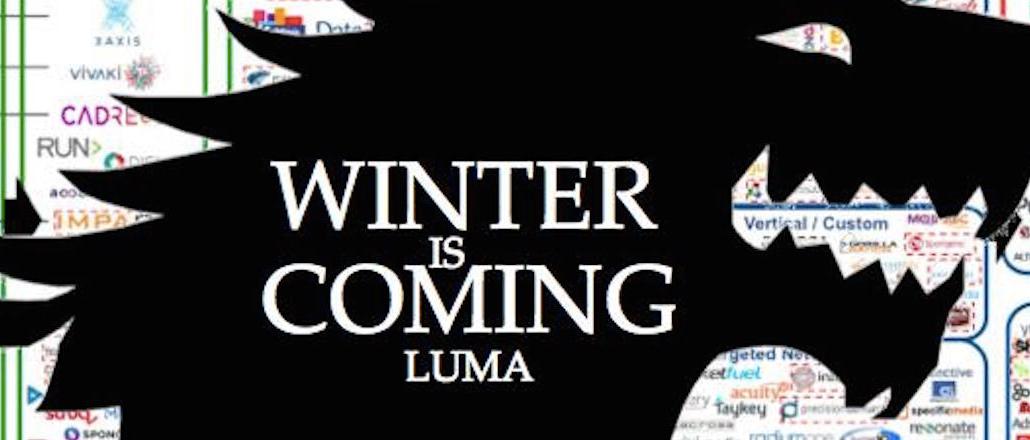
There’s a reckoning coming in the ad tech industry. There are far more venture-backed companies than there are opportunities for successful exits, and numerous investors will be left without their shirts once the dust has settled, according to Terry Kawaja, founder and CEO of Luma Partners.
Luma Partners, the influential investment bank that specializes in the digital media industry, recently conducted a comprehensive analysis of more than 2,000 ad tech companies, and its conclusion was not optimistic: Only 150 of them are poised for a liquidity event, Kawaja said over dinner at the annual IAB leadership meeting on Sunday night.
He foresees the ensuing chaos playing out like an episode of “Game of Thrones”: struggling firms will have to sell and swear allegiance to pre-existing fiefdoms, with those 10 to 15 conglomerates vying with one another for a spot on the ad tech Iron Throne.
This mass consolidation has already begun to manifest itself in the market, with AOL, Facebook, Google and Yahoo buying up ad tech companies at an alarming rate in recent years, he said.
AOL has acquired five ad tech companies (Adap.tv, Gravity, Convertro, Precision Demand and, most recently, Vidible) in the past year and a half alone. Facebook has invested heavily in ad tech in recent years, most notably with its re-release of Atlas, the ad server it bought from Microsoft in February 2013, this past September. Facebook also acquired video ad tech company LiveRail in July 2014.
Yahoo got in on the acquisition action, too, last year, purchasing mobile ad firm Flurry in July followed by its purchase of video ad network BrightRoll in November.
And Google has been the most aggressive; With its 2014 acquisition of Adometry, it became the only company to have a foothold at nearly every step of the programmatic ad-buying process. (Google does not have a data management platform, but is believed to be building one.)
Ad position: web_incontent_pos1
Uncertainty about the viability of ad tech companies has been reflected in the stock market, where stock prices for newly public ad tech companies have been volatile.
Kawaja is not alone in his bleak assesment. AOL CMO Allie Kline said that many ad tech companies offer a solution that would (and probably should) be nothing more than a product feature in a larger company.
It was also on the mind of Jason Fairchild, co-founder of ad exchange OpenX, as his company hosted an invite-only cocktail party on Monday replete with a scotch tasting and hand-rolled cigars.
There are no days off in ad tech, he said. Companies that rest on their laurels soon see their technological advantages co-opted by competitors, leaving them undifferentiated in an already crowded market.
If anyone should have an accurate read on the current state of the industry its Kawaja’s Luma Partners, whose signature “Lumascapes” — graphical breakdowns of the complicated worlds of ad tech — have become fixtures within the industry. Many even use the word Lumascape as shorthand for ad tech industry.
Ad position: web_incontent_pos2
Consolidation will not necessarily make the Lumascape any easier to read, however — Kawaja predicts that the ad tech company creation will more or less keep pace with the number of failures.
As any “Game of Thrones” fan can tell you, there’s always someone else waiting for his chance to contest for the kingdom.
Image courtesy Terry Kawaja
More in Media

What publishers are wishing for this holiday season: End AI scraping and determine AI-powered audience value
Publishers want a fair, structured, regulated AI environment and they also want to define what the next decade of audience metrics looks like.

Digiday+ Research Subscription Index 2025: Subscription strategies from Bloomberg, The New York Times, Vox and others
Digiday’s third annual Subscription Index examines and measures publishers’ subscription strategies to identify common approaches and key tactics among Bloomberg, The New York Times, Vox and others.

From lawsuits to lobbying: How publishers are fighting AI
We may be closing out 2025, but publishers aren’t retreating from the battle of AI search — some are escalating it, and they expect the fight to stretch deep into 2026.
Ad position: web_bfu