Save 50% on a 3-month Digiday+ membership. Ends Dec 5.
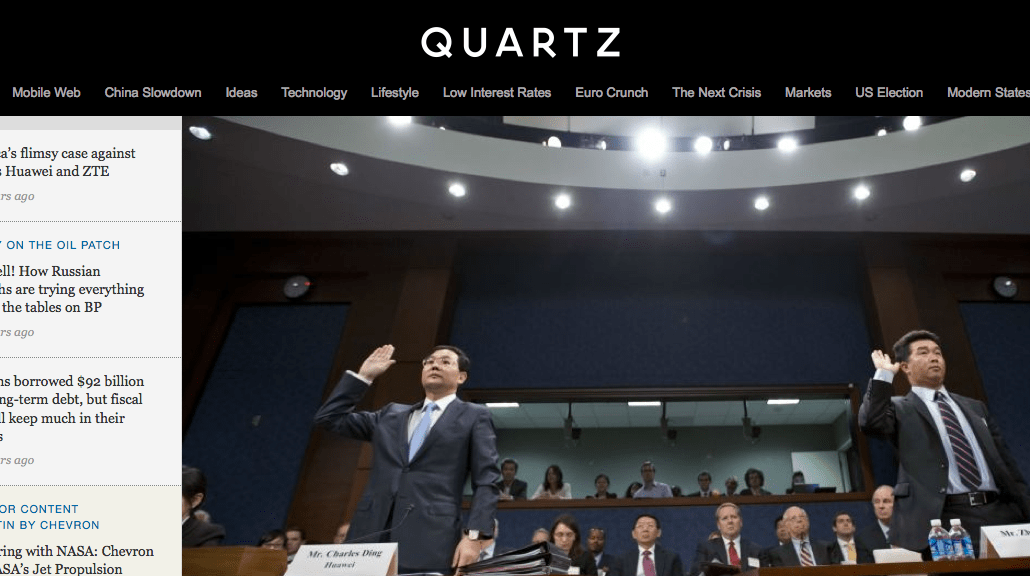
While some publishers have de-emphasized the homepage as visitors increasingly come through social side doors, Quartz going in the opposite direction: It plans to refresh its landing page by the end of the year.
Quartz only introduced a homepage in 2014, and a pared-down one at that. Modeled on its Daily Brief email newsletter, its homepage consists of an updated stream of stories.
But with Quartz’s 60-strong global editorial team pushing out 50 to 60 pieces a day, the 3-year-old site wants to make more of its content visible, with more links and ways for readers to move around the site, according to Jamie Labate, Quartz’s digital director across EMEA (Europe, Middle East and Africa). Traffic to Quartz’s homepage has remained steady, at 10 percent of traffic, and the idea behind the refresh is to boost return visits and loyalty with those readers, he said.
“We’ll maintain the style you expect with Quartz,” he told Digiday. “We’re keeping it visual and simple. The content will be front and center, and the continuous scroll will still be there.”
Quartz’s increased content has come in part thanks to its global expansion. About half of Quartz’s 15 million global monthly unique visitors come from outside of the U.S. The publisher launched in India in March 2014 and now gets about 500,000 monthly uniques from that country (comScore). Quartz Africa followed this summer and plans to grow its readership there to 1 million monthly uniques within a year.
Along with more editorial content, the homepage also will feature more native ad placements, a change that could help Quartz capture more branded content ad dollars, said James Harris, chief digital officer at media agency Carat Global.
Some of Quartz’s native ads, called Bulletins, have performed as well as editorial content, averaging seven to eight minutes of engagement, according to the publisher. But these formats take a lot of time and resources to create.
Ad position: web_incontent_pos1
Expanding its global footprint also will require making sure the coverage reflects that ambition, Harris said. “A lot of the content [on Quartz] is still very U.S.-focused,” he said. “The Huffington Post has been incredibly successful because its editorial team is culturally diverse. Brands with a global remit will find it difficult to go up against that content.”

More in Media

What publishers are wishing for this holiday season: End AI scraping and determine AI-powered audience value
Publishers want a fair, structured, regulated AI environment and they also want to define what the next decade of audience metrics looks like.

Digiday+ Research Subscription Index 2025: Subscription strategies from Bloomberg, The New York Times, Vox and others
Digiday’s third annual Subscription Index examines and measures publishers’ subscription strategies to identify common approaches and key tactics among Bloomberg, The New York Times, Vox and others.

From lawsuits to lobbying: How publishers are fighting AI
We may be closing out 2025, but publishers aren’t retreating from the battle of AI search — some are escalating it, and they expect the fight to stretch deep into 2026.
Ad position: web_bfu