Save 50% on a 3-month Digiday+ membership. Ends Dec 5.
Facebook has quietly altered its ad policy to allow brands to show ads more frequently to those who don’t already follow the brand.
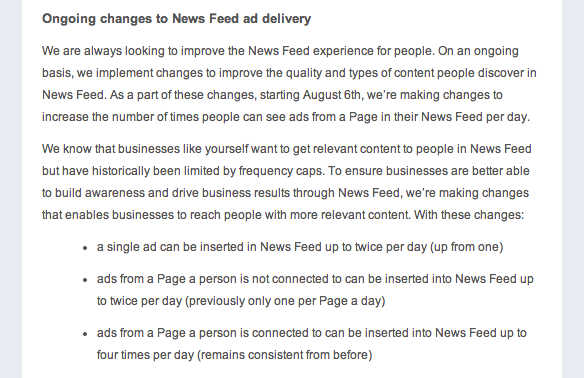
Brands are now able to hit users with the same news feed ad twice in a given day, whereas previously brands were only able to do so once per day. Similarly, the number of news feed ads brands can serve users they are not connected to — users who have not liked that brand’s Facebook page — has risen to two daily from one. The number of news feed ads brands can serve to their page followers will remain at four, and the total number of ads a Facebook user can see in a given day will also not increase.
Facebook announced the changes in an email it sent to agencies this month.
While the change affords brands greater frequency for their Facebook ads, it also creates a risk of Facebook users becoming annoyed with brands and, correspondingly, Facebook itself.
“These changes raise the stakes,” OMD’s chief digital officer Ben Winkler told Digiday. “Advertisers who send out high-quality, relevant messages will benefit. Those who don’t, will do so at their own peril. People like great content, regardless of the source. But they have zero tolerance for one bad ad, let alone two.”
Jeff Semones, president at M80, said the move is just the latest sign that social media advertising is no longer, in fact, social. The old-school view of social media, he said, was that it would be digitized word-of-mouth marketing: brands would inspire customers, and those customers would in turn speak favorably about the brand on social media. The modern view of social is that it’s an advertising medium like any other.
Ad position: web_incontent_pos1
“We tell our clients to think of Facebook less like a social network, and more like an advertising network,” Semones added.
Facebook’s transformation from a platform for well-crafted creative to merely a platform with reach has been a constant refrain during weeks, especially among attendees at Digiday’s inaugural Platform Summit last week.
“Facebook is now a place to drive reach to your content-marketing programs and less a place to be the center of your architecture,” 360i chairman Bryan Wiener said on Thursday.
Nestle digital manager Emily Cloud said on Thursday that the company has even begun repurposing images posted to Facebook for Pinterest.
And in late July, Sean Ryan, JCPenney’s director of social and mobile marketing, likened Facebook ads to “display ads on steroids.”
Ad position: web_incontent_pos2
Enthusiasm for Facebook has not waned in light of these changes, however. And Winkler thinks that consumers’ may have a greater tolerance for repeat ads than some perceive.
“As long as Facebook continues to improve their product and their ad-targeting, that level may be higher than you think,” he said.
More in Media

What publishers are wishing for this holiday season: End AI scraping and determine AI-powered audience value
Publishers want a fair, structured, regulated AI environment and they also want to define what the next decade of audience metrics looks like.

Digiday+ Research Subscription Index 2025: Subscription strategies from Bloomberg, The New York Times, Vox and others
Digiday’s third annual Subscription Index examines and measures publishers’ subscription strategies to identify common approaches and key tactics among Bloomberg, The New York Times, Vox and others.

From lawsuits to lobbying: How publishers are fighting AI
We may be closing out 2025, but publishers aren’t retreating from the battle of AI search — some are escalating it, and they expect the fight to stretch deep into 2026.
Ad position: web_bfu