Save 50% on a 3-month Digiday+ membership. Ends Dec 5.
Speed tweaks and a new look help Bleacher Report keep users glued to its app.
To speed up load times, over the past year Bleacher Report started natively uploading tweets, GIFs and Instagram posts within its app, rather than pulling them from the mobile web. For now, Bleacher Report’s articles still load from the mobile web, but the publisher is looking into adopting Google AMP for its in-app articles to get another speed boost. In April, the sports publisher also launched its own mobile video player and redesigned its app to include tabs and focus more on national sports coverage.
Bleacher Report users, on average, spent 151 minutes in its app per month this past year, according to comScore data. This was the highest among major sports publishers, as the top five sports apps in terms of time spent (excluding Bleacher Report) averaged 82 minutes per user per month.
“The redesign was the last piece of a lot of ‘under the hood’ work that we’ve done,” said Chris Nguyen, Bleacher Report’s vp of product. “We’ve invested our energy to make sure we can control the [mobile] experience.”
Bleacher Report is investing in mobile video product at a time when both mobile and video are rapidly growing. With mobile eating digital media, speed has become increasingly important in keeping users’ attention, which has led many publishers to adopt fast-loading features like Facebook Instant Articles and Google AMP. To boost speed and reduce vendor costs, Bleacher Report replaced video vendors Ooyala and Akamai with its own mobile video player.
Since the redesign, Bleacher Report’s in-app videos load within 1.2 seconds, on average, on both Android and iOS, according to video analytics firm Conviva. Per Conviva, the median video load time for publishers is 5.6 seconds on Android and 4.2 seconds on iOS. Bleacher Report declined to provide year-over-year statistics since it switched analytics vendors with the redesign.
The video player has been frequently used since the redesign. One-third of the app’s users use one of the app’s new tabs, Fire, which features silent autoplay videos on a loop, similar to the now-defunct Vine.
Ad position: web_incontent_pos1
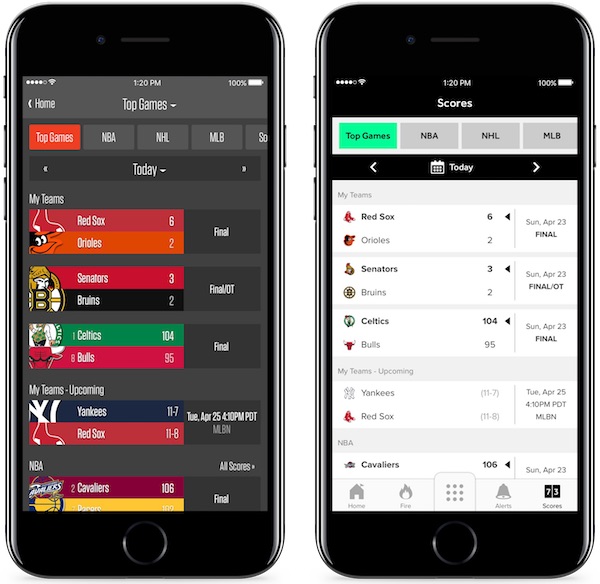
Users who visit Fire stay in the app for 24 percent longer than non-Fire users, said Nguyen, who declined to share raw numbers. In its first month, users watched 150 million video loops on Fire, which lets people quickly scroll through the top sports highlights throughout the nation. Most of the app’s other features focus predominantly on the user’s selected favorite teams.
“We view every tab like it is its own app within the app,” Nguyen said. “We wanted to create an addictive habit around something that isn’t your team.”
About 3 million people use Bleacher Report’s app each month, according to comScore, which means that it still has a long way to go before it catches up with ESPN’s app audience of more than 13 million monthly visitors.
“We might not have as large of breadth,” Nguyen said. “But our engagement is really strong.”
More in Media

What publishers are wishing for this holiday season: End AI scraping and determine AI-powered audience value
Publishers want a fair, structured, regulated AI environment and they also want to define what the next decade of audience metrics looks like.

Digiday+ Research Subscription Index 2025: Subscription strategies from Bloomberg, The New York Times, Vox and others
Digiday’s third annual Subscription Index examines and measures publishers’ subscription strategies to identify common approaches and key tactics among Bloomberg, The New York Times, Vox and others.

From lawsuits to lobbying: How publishers are fighting AI
We may be closing out 2025, but publishers aren’t retreating from the battle of AI search — some are escalating it, and they expect the fight to stretch deep into 2026.
Ad position: web_bfu